 Sun Corridor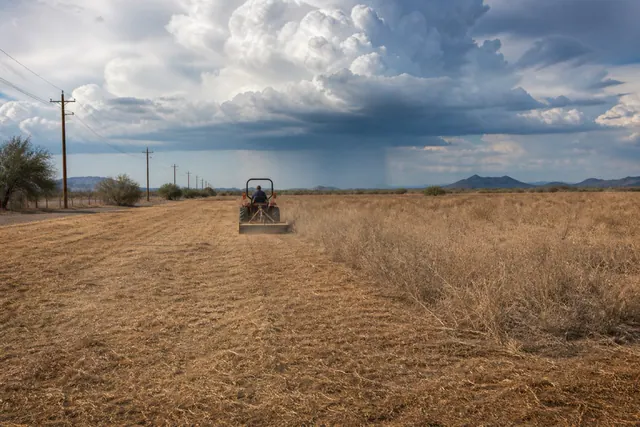
Sun Corridor Land Clearing connects Chandler property owners with a local land clearing contractor for brush & underbrush clearing in Chandler and down the Sun Corridor.
Brush clearing is the maintenance end of the trade: not the mesquite forest, but the waist-to-shoulder-high growth that takes over a corridor parcel in a season or two — desert broom on any disturbed ground, Russian thistle drying into rolling fuel by June, and the flush of annuals that follows a wet winter. A tractor with a heavy rotary cutter or a compact machine with a brush mower takes it back to stubble in hours, and the parcel reads as cared-for again.
Around Chandler the trigger is often a letter: cities and counties across the corridor cite overgrown lots as fire and health hazards, and vacant-parcel owners from the Price Corridor edge down to Arizona City get notices every early summer as the annuals cure. Clearing before the letter is cheaper than clearing on a deadline — and much cheaper than being the lot a neighbor's insurance adjuster photographs after an ember event.
The other steady customers are acreage owners keeping their own ground usable: horse setups that need the tumbleweed knocked down before it fences itself along the pipe rail, well and septic access kept open, and the strip between a manufactured home and the section-line road kept low so visibility and fire separation both hold. It is quick work with the right machine and miserable work without one.
Reading corridor brush: what grows back and what doesn't
Not all of the green on a neglected parcel is equal. Creosote and bursage are the slow, stable natives — mow around them and they mostly mind their own business. Desert broom is the opposite: a disturbance specialist that seeds into graded ground by the thousand and can put on six feet in two seasons. Tumbleweed cures into a mobile fire hazard that stacks itself against the first fence it meets. A clearing pass that distinguishes between them — keeping the stable natives, cutting the invaders hard — leaves a parcel that stays presentable far longer than a blind scrape. The Arizona Cooperative Extension is the best local reference for telling one from the other.
Mowing height matters too. Cutting annuals at a few inches preserves the soil crust that keeps this basin's powdery loam from lifting into the wind — scalping to bare dirt just invites both dust and the next generation of broom. The goal is stubble, not sterilized ground.
The June deadline every vacant-lot owner should circle
By mid-June the winter annuals are fully cured, daytime humidity is in the single digits, and the monsoon's dry-lightning phase is arriving — the NWS Tucson office, which covers the southern half of this service area, flags those fire-weather days all summer. A brushy lot in that window is a liability measured in minutes. Owners who put clearing on the calendar for April or May consistently pay less and never meet the code officer.
For parcels near homes, pair the mow with a defensible-space look at the structures themselves; the national Firewise USA program lays out the zone distances that make an ember-driven fire survivable. Brush clearing is the acreage-scale half of that same logic.
Further reading
Good to know
How often does a vacant lot near Chandler need clearing?
Most owners settle into once a year, in late spring after the winter annuals cure and before fire season peaks. A wet winter can force a second pass; a dry one can stretch the interval. Desert broom areas regrow fastest and set the schedule.
What does it cost to mow brush off an acre?
Light annual growth on flat ground is the cheapest work in the catalog — often a few hundred dollars for a small lot. Mixed brush with woody volunteers costs more because the machine slows down. The quote is itemized after a look at the actual growth, not guessed from an aerial.
Can you clear around my existing trees and cactus?
Yes. Established mesquites you want shading the yard, any saguaro or barrel cactus, and irrigation lines all get flagged before the first pass. The cutter works around keepers easily; protected natives are never touched regardless.
I got an overgrowth notice from the city — how fast can this happen?
Simple mow-downs are the easiest jobs to slot into a route, and most notices carry a compliance window measured in weeks. Send the notice text with your quote request so the scope matches exactly what the inspector cited.
Will mowing stir up a huge dust cloud?
A brush mow disturbs far less soil than blading, and operators work with water available and wind in mind — this corridor takes dust seriously, with parts of Pinal County under federal PM10 rules. Cutting to stubble instead of scraping bare is the main protection.