 Sun Corridor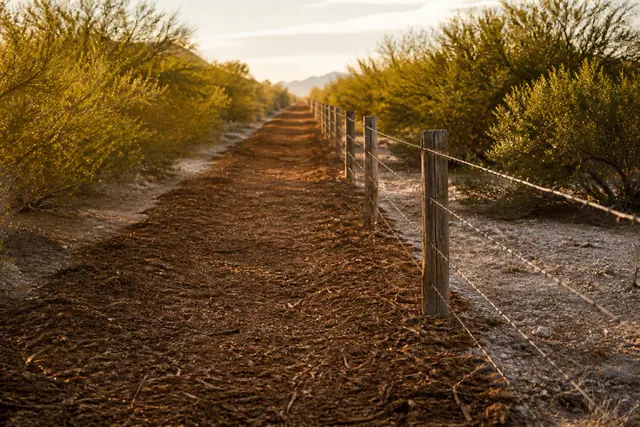
Sun Corridor Land Clearing connects Chandler property owners with a local land clearing contractor for fence line clearing in Chandler and down the Sun Corridor.
Fence lines are where the desert wins by inches. Mesquite volunteers root where birds perch on the wire, tumbleweed stacks itself into the mesh until wind load leans the posts, and a decade of neglect turns a legal boundary into a thicket nobody can survey, repair, or rebuild through. Fence-line clearing runs a mulcher down the corridor — typically a swath of six to twelve feet — and gives the owner back a line that can be walked, strung, and maintained.
The work has a rhythm particular to old ag country. Section-line fences outside Stanfield or Coolidge run dead straight for a quarter mile with a mesquite at every third post; ranchette perimeters near Arizona City mix field fence, pipe rail, and improvised patches that all have to be found before a drum head works next to them. Operators clear tight to the wire from both sides where access allows, then hand-cut the growth actually inside the fence so the machine never argues with steel.
Owners usually order this work for a concrete reason: a survey or sale that needs the corners found, a fencing contractor who quotes rebuilds much lower on cleared line, livestock going onto a parcel whose old wire needs inspection first, or a boundary dispute where the actual line has to be visible to be discussed. Whatever the trigger, the finish is the same — a clean corridor, chips left down to slow the regrowth, and every corner post standing in the open.
Why cleared line cuts your fencing bill in half
Fence contractors price uncertainty. A rebuild quoted through brush carries allowances for hidden wire, buried posts, unknown grade, and hand-clearing time; the same run quoted on a clean corridor is just posts, wire, and footage. Owners who clear first routinely find the fencing quote drops enough to cover the clearing — and the new fence goes in straighter, because the builder can sight corner to corner. On old field boundaries, knocking down the plow berm that built up along the line also stops the next generation of volunteers from rooting into damp, sheltered soil at the wire.
Where the boundary doubles as a firebreak — common on parcels backing open desert — the cleared swath earns its keep twice, functioning as the fuel gap described in Firewise USA guidance. Ten mulched feet along a property line is often the only fuel break a rural neighborhood has.
Property lines, neighbors, and doing this work right
A fence-line job touches the most legally sensitive strip of any parcel, so the setup is procedural: confirm the line — a recorded survey beats an old fence's opinion, and Pinal County parcel records are the starting point south of the county line — talk to the neighbor whose brush inevitably grows through from the other side, and locate any utilities that run the corridor, since power and irrigation lines love the same straight paths fences do. Five minutes of paperwork prevents the only genuinely bad outcomes this work can have.
Protected natives get the same treatment on a line as anywhere else: a saguaro standing in the fence corridor stays, and the wire routes around it the way it always has. The Cooperative Extension has helpful material on managing vegetation along rural boundaries without stripping the habitat value that fence rows quietly provide.
Further reading
Good to know
What drives the per-foot price of fence-line work?
Light brush on accessible line is inexpensive per foot; dense mesquite corridors where the machine works slowly and hand crews finish at the wire cost several times more. Quotes are walked and priced by the run, with long section-line jobs often phased by quarter mile.
Can you clear right up against old barbed wire?
The machine works close; the last couple of feet and anything grown through the wire is hand work — a drum mulcher and loose wire are a bad combination for everyone. That split is standard and included in how the job is priced.
My neighbor's brush is pushing through the fence. Whose job is it?
Arizona boundary-fence customs and any recorded agreements govern the legal answer, but the practical one is a conversation — many jobs end up split, or done from one side with the neighbor's permission to reach over. The contractor can work either arrangement; the talking part is yours.
How wide a swath should I clear?
Six feet serves inspection and repair; ten to twelve gives a fencing crew working room and doubles as a fuel break. Wider than that you're into field-edge clearing, which is fine — it just gets priced as area rather than line.
Will the mesquite along the fence just grow back?
Mulched to grade, some will resprout — a fence line is the classic place for a cheap annual touch-up pass. If you want the line permanently woody-free, grubbing the crowns along the run costs more once and ends the cycle.