 Sun Corridor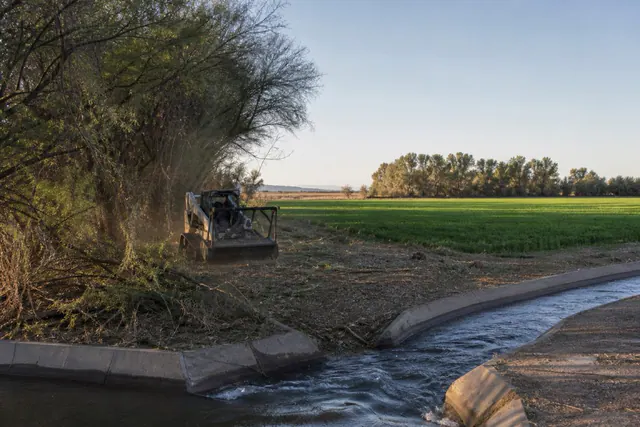
Sun Corridor Land Clearing connects Valley Farms property owners with a local land clearing contractor for land clearing, brush removal, and lot clearing across the Valley Farms area.
Valley Farms sits in the irrigated pocket east of Coolidge where the corridor's water story is still visibly alive: alfalfa fields flood-irrigated off concrete laterals, cottonwood lines marking the Gila River's course to the north, and — because water attracts wood — some of the densest mesquite bosque growth in the service area crowding every field corner, ditch junction, and fallow strip the district's water can reach.
That density defines the work. Where most corridor clearing is spaced creosote and scattered mesquite, Valley Farms jobs run into true thicket: multi-trunk velvet mesquite interlocked over ditch banks, salt cedar threading through wherever maintenance lapsed, and regrowth that comes back fast because the moisture never leaves. Mulchers earn their keep here more than anywhere else on the map, grinding thicket edges back to a maintainable line while the root structure keeps holding the bank.
The clientele is working ground: farm operations keeping field corners turnable and ditches flowing, acreage owners whose parcels border the district's laterals, and buyers converting a fallow irrigated parcel to horse or homesite use — the best possible dirt for either, once the wood is managed and the buried pipe is mapped. Jobs coordinate with the irrigation schedule as a matter of course; the dry window is the working season on anything touching a ditch.
Working the bosque: clearing where the water table is close
A mesquite bosque is the desert's version of a floodplain forest, and near the Gila's course it behaves like one: root systems plumbed into shallow moisture, growth rates double the dry-flat norm, and shade dense enough to matter in July. Clearing decisions are correspondingly less absolute — most owners want the bosque edge pushed back and held, not eliminated, keeping the shade and the wildlife while recovering the field corner or the fence line. The cut-line-and-maintain pattern does exactly that, with an annual touch-up while regrowth is green and cheap. River-system vegetation dynamics in this basin are well covered by the USGS, and species-level management by the Arizona Cooperative Extension.
Salt cedar inside a bosque gets no such courtesy: it's removed on sight, crowns and all, before it converts a native stand into a monoculture.
Buying fallow irrigated ground here: a clearing checklist
Valley Farms parcels change hands with their infrastructure attached, and the pre-purchase walk should read it: standpipes and gates locate the delivery points, the berm pattern shows how the field watered, and the state of the ditch concrete hints at what restoration would cost. Post-purchase, the clearing sequence is mow, grub the woody volunteers, knock down or preserve borders depending on whether the ground will irrigate again, and rip where decades of traffic packed the pan. Jurisdiction is unincorporated Pinal County, with Coolidge as the service town next door.
Owners planning horses or a homestead on this dirt are starting from the best soil in the corridor — the clearing job is mostly about honoring the plumbing while converting the surface.
Further reading
Good to know
Can you clear mesquite thicket without killing the whole stand?
Yes — edge management is the standard Valley Farms job: the mulcher establishes a clean line where you need open ground and the stand behind it stays intact. Expect faster regrowth here than on dry flats; the maintenance pass is part of the honest plan.
How does work get scheduled around irrigation deliveries?
Ditch-adjacent jobs slot into the dry windows, coordinated with your delivery schedule so machine access and clean channels never conflict with water. Field-interior work runs anytime. It's a normal constraint here and quoting accounts for it.
Is the salt cedar in my ditch row worth removing if the neighbors still have it?
Yes — every removed stand cuts seed pressure and recovers your own capacity and ground, even if reinvasion pressure continues from upstream. Districts and neighbors often coordinate segments for exactly that reason; the work phases along the run cleanly.
What does bosque-edge clearing cost?
It's the denser end of corridor pricing — thicket slows the machine and the wood volume is real — but mulch-in-place keeps haul costs near zero. Priced per parcel after a walk, with edge-hold maintenance quoted alongside so the second-year cost is known upfront.
Are there protected plants in these thickets?
Occasionally — an ironwood grown into a bosque edge, or a saguaro on the parcel's dry corner. The pre-work walk flags anything protected under Arizona's native plant law, and clearing routes around it as it does everywhere in the state.