 Sun Corridor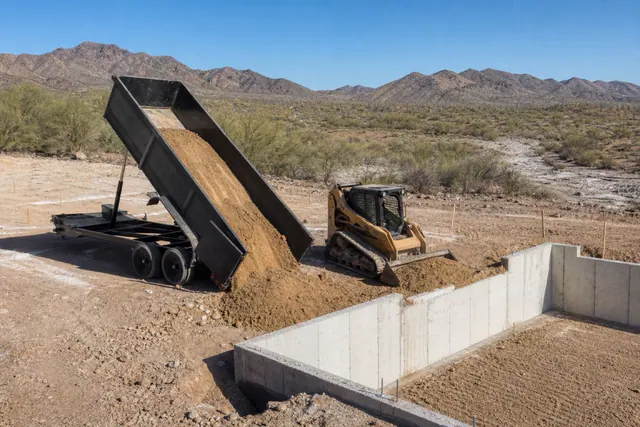
Sun Corridor Land Clearing connects Chandler property owners with a local land clearing contractor for fill dirt services in Chandler and down the Sun Corridor.
Flat as this basin looks, almost every project on it needs dirt moved in or up: a pad lifted proud of the surrounding grade so monsoon sheet flow goes around the house instead of through it, a scoured wash-out along a drive healed back to grade, a low corner of a parcel brought up before a shop slab, trench spoils replaced with material that actually compacts. Fill service covers the supply, the spreading, and — the part that separates professionals — the compaction.
Material honesty matters more with fill than any other dirt product, because bad fill is invisible until something sits on it. Clean native loam and screened fill compact predictably; 'free dirt' from an unknown excavation can carry trash, expansive clay lenses, or organics that decay into voids. Structural applications get structural material placed in six-to-eight-inch lifts, moisture-conditioned, and rolled to spec — while a berm or a landscape mound can use economical common fill. The quote names which material goes where and why.
Fill work pairs naturally with clearing on the same mobilization. The lot being cleared for a manufactured home usually needs its pad lifted; the driveway being cut usually has one soft crossing that wants engineered fill; the reclaimed field has a borrow hump to spread into its own low spots — often the cheapest fill there is, since it's already on the parcel. Combining the scopes saves the second machine move, which on rural corridor addresses is a real line item.
Lifts, moisture, and why pads fail ten years later
Fill placed in one deep push and driven over a few times feels solid the week it's done — and settles for a decade, cracking whatever was built on it. Proper placement is boring on purpose: thin lifts, each wetted to near its optimum moisture, each compacted before the next, with testing where a structure will follow. In this basin's soils the moisture step is non-negotiable; the native loam is far too dry in place to densify, and caliche-derived fill needs conditioning time for the moisture to work in. Parcel-level soil behavior is queryable through the USDA Web Soil Survey before the first load arrives.
The premium for doing it right is small against the cost of doing it twice — releveling a settled manufactured home or mud-jacking a shop slab both start where a compaction shortcut ended.
Raising grade without flooding the neighbor
Fill changes where water goes, and on corridor flats where everyone shares the same sheet flow, raising your ground carelessly sends the storm to the parcel next door — the classic rural dispute. The right pattern lifts the pad and feathers the new grade to drain along historic paths, keeps fill out of mapped washes, and checks floodplain status before committing serious yardage; Pinal County and the City of Chandler each publish their floodplain and drainage rules. Monsoon-season deliveries also plan around storm days, because a fresh, uncompacted stockpile in an August cell becomes a mud delivery. The NWS Phoenix forecast is part of the scheduling toolkit.
Where the water question is genuinely complicated — parcels against washes or with visible flow paths — the honest answer may involve an engineer before an operator, and a contractor who says so is saving you money, not spending it.
Good to know
What does fill dirt cost delivered around the corridor?
Price rides on material class and haul distance more than anything — common fill close to a pit is cheap per yard, screened structural material delivered far down a rural route costs multiples. The quote prices supply, spreading, and compaction separately so the total is legible.
How much fill do I need to raise my pad a foot?
Rough math: a yard of compacted fill covers about 27 square feet at one foot deep — call it a hundred-plus yards for a modest home pad once shrinkage is counted. The estimator measures and does that arithmetic for your actual footprint rather than guessing.
Can you use dirt from my own property?
Often yes, and it's the cheapest option when a high spot or old berm can donate — the material gets evaluated first, since not everything on a parcel is fit to bear load. Cut-and-fill within the parcel also keeps trucks off the road, which the neighbors appreciate.
Is compaction really necessary for a shed or coop?
For light, repairable structures, a well-spread and wheel-rolled surface may serve. For anything with a slab, plumbing, or leveling jacks, placed-and-compacted is the only spec that doesn't gamble. It's a small delta on a small pad.
Do washes on my land limit where fill can go?
Yes — filling a wash without engineering and, where required, permits invites both flooding and liability. The workable pattern is lifting your build area and leaving the wash its path, or hardening a crossing properly. The site walk maps that before any yardage is ordered.