 Sun Corridor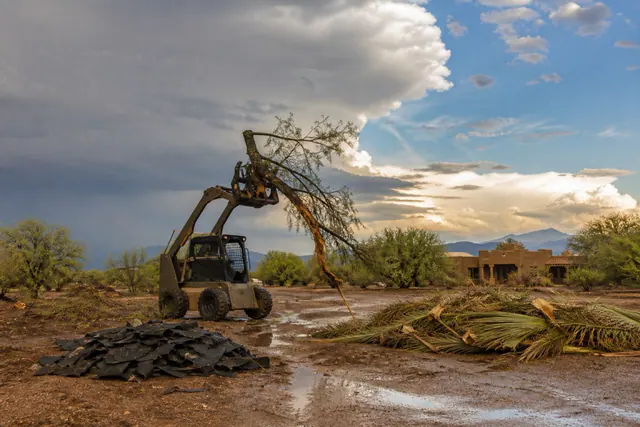
Sun Corridor Land Clearing connects Chandler property owners with a local land clearing contractor for storm debris cleanup in Chandler and down the Sun Corridor.
The corridor's storms are short and specific: a monsoon cell arrives with a wall of dust, drops sixty-mile-an-hour outflow winds and a violent inch of rain, and is gone in forty minutes — leaving behind snapped athel windbreaks, uprooted palo verdes, a trampoline in the neighbor's field, and shredded palm fronds across a quarter section. Storm cleanup is the trade's rapid-response mode: grapple machines and chippers converting a chaotic parcel back into an ordered one, usually within days.
Desert trees fail in storms for predictable reasons, and the wreckage shows it. Palo verdes shear at weak multi-trunk unions; over-watered mesquites grown fast and soft uproot whole because irrigated lawns never made them anchor; aleppo pines drop massive laterals; and the old athel tamarisk windbreaks around farmhouses — brittle by nature — shed tonnage every big blow. Clean-up triage sorts what fell: hazard wood off structures and drives first, then bucking and hauling, then the judgment calls on leaning survivors that will not survive the next cell.
The insurance dimension is real on bigger events. Documented photos before the machines start, itemized invoices that separate hazard removal from general cleanup, and honest calls on which damaged trees are claims versus maintenance all make the adjuster conversation easier. And because monsoon damage clusters — one outflow boundary can rake Stanfield, Casa Grande, and Arizona City in an afternoon — getting a request in early puts a parcel at the front of a route that fills fast.
After the microburst: a triage order that works
First: anything on or against a structure, a vehicle, or the power drop — and nothing touching a line gets handled by anyone but the utility. Second: the driveway and gates, so the property functions. Third: the broken-but-hanging wood overhead, which is the most dangerous material on the parcel and the least obvious to untrained eyes. Only then does the general debris matter. The NWS Phoenix office issues the severe-thunderstorm and dust-storm warnings that precede these events; their damage-survey pages afterward are also how a neighborhood learns whether it took a microburst or something rarer.
Homeowners can safely stage small material at the drive edge, but the chainsaw-on-a-ladder phase of storm cleanup is statistically the most dangerous thing a property owner can attempt — bound limbs under tension and half-failed unions release without warning. That is precisely the wood a grapple exists for.
Rebuilding a parcel that fails better next time
Every storm is an audit. The trees that failed usually explain themselves — bad unions, girdled roots, species planted beyond their strength — and the cleanup visit is the right moment to prune or remove the survivors showing the same defects, while the equipment is on site and the evidence is fresh. Windbreak rows deserve particular attention: a gap-toothed athel line funnels wind instead of breaking it, and sometimes the honest recommendation is finishing what the storm started and replanting with something that holds. General preparedness guidance at Ready.gov covers the household side of severe-weather readiness.
Debris strategy matters afterward too: chips from the cleanup make excellent cover for the bare spots the storm scoured, and hauling only the trunk wood keeps the invoice down. Dust left hanging over the corridor can be tracked through AirNow before outdoor cleanup resumes. A parcel put back together this way looks better than it did before the storm — and sheds the next one with less to clean.
Further reading
Good to know
How soon can help show up after a big storm?
Hazard calls — wood on structures, blocked drives — go to the top of the route sheet, with arrival commonly inside a day or two depending on how wide the damage swath ran. General cleanup slots follow. Calling with photos moves your scoping along fastest.
Does insurance pay for storm tree cleanup?
Policies commonly cover removal when a tree damages covered structures, with limits, and vary on debris that simply fell. Photograph everything before cleanup starts, keep the itemized invoice, and ask your carrier early — the contractor's paperwork is written to be adjuster-friendly.
My tree is leaning after the storm but didn't fall. Now what?
A lean that appeared overnight means root failure — the tree has already moved and rarely re-anchors, especially in soaked soil. Treat it as a removal-soon, and keep people and vehicles out from under it in the meantime. It's a quick assessment on a cleanup visit.
Is the debris hauled off, or left piled on site?
Either. Full haul-off leaves the parcel clean; chip-on-site is cheaper and gives you ground cover; stack-and-leave for firewood is free beyond the cutting. Most jobs mix all three, itemized so you choose.
What about the neighbor's tree that landed on my side?
Common after every big cell. Generally the debris on your property is yours to clear regardless of where the trunk stands — liability shifts if the tree was a known, documented hazard. Clear it, document it, and have the fence-line conversation once the yard is functional.