 Sun Corridor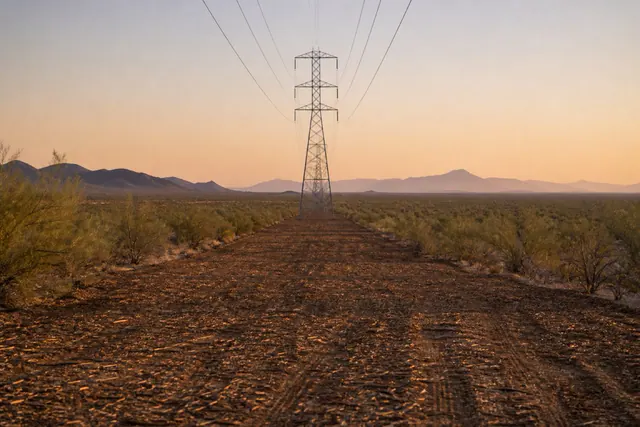
Sun Corridor Land Clearing connects Chandler property owners with a local land clearing contractor for right-of-way clearing in Chandler and down the Sun Corridor.
Right-of-way work is clearing as infrastructure maintenance: the long, linear corridors that keep the Sun Corridor functioning — power line easements marching across creosote flats, irrigation district laterals and their access roads, canal banks, pipeline routes, and the road shoulders where visibility is a safety spec, not an aesthetic one. The product is a corridor held to a defined width and vegetation height, delivered on schedule, with documentation the asset owner can file.
The vegetation says what the work is. Mesquite and salt cedar are the repeat offenders on anything that carries or borders water, growing back toward the moisture on a schedule you can calendar; desert broom colonizes every graded shoulder; and under transmission spans, the clearance question is regrowth rate versus inspection cycle. Mulching is the default tool — it leaves root structure holding the bank or shoulder, spreads chips that suppress the next cycle, and produces no burn piles or haul convoys along a live corridor.
Corridor work also carries corridor-specific discipline: locates and clearances before machines work near energized spans or pressurized lines, traffic control where the right-of-way is a road shoulder, dust suppression across miles of disturbance rather than one lot's worth, and protected natives — saguaros standing inside utility easements are a signature Arizona sight — flagged and preserved exactly as they are on private ground. Crews that live in this niche run tighter checklists than any other clearing discipline, because the client is often auditing.
Scoping linear work: miles are not acres
Linear clearing prices differently than parcel clearing because the variables repeat by the mile: average density, access point spacing, how often the machine must walk versus work, and what share of the corridor needs hand crews around structures. A good scope samples the corridor's density classes, fixes the spec — width, cut height, treatment of woody regrowth — and prices per mile by class, which lets the asset owner phase the worst segments first. Weather windows fold in too: ditch and canal banks clear best in the dry season when flows are down, and fire-weather days pause hot work along cured grass corridors, per the red-flag calendar the NWS Phoenix office maintains.
Documentation completes the job on corridor work — before-and-after imagery by station, notes on protected plants left in place, and a regrowth forecast that makes next cycle's budget an estimate instead of a surprise.
Fuel breaks and the public-safety side of the corridor
A maintained right-of-way is quietly one of the region's main fire-defense assets: a mulched easement or clean ditch bank is a ready-made fuel break between open desert and the subdivisions this corridor keeps building. That logic — remove the continuous fine fuel, hold the gaps — is the same one the Firewise USA program applies at the neighborhood scale, and it is why HOAs and districts increasingly fund shoulder and easement clearing as fire mitigation rather than mere tidiness. Invasive control rides along naturally, since the corridors are how buffelgrass and salt cedar travel; guidance from the Arizona Cooperative Extension covers the species-level tactics.
For districts and boards weighing the spend: the cheapest year to clear a corridor is always this one. Linear vegetation compounds, and the bid for a corridor five years overgrown reads like a different industry.
Good to know
Who typically hires right-of-way clearing?
Irrigation and drainage districts, HOAs and community associations, private road groups, farm operations with long ditch systems, and contractors maintaining utility easements. Individual owners also order it for shared easements crossing their land — often splitting cost among the parcels served.
Can you work under energized power lines?
Ground-level mulching within an easement is routine with proper clearances and locates; anything requiring work near the conductors themselves belongs to the utility's own qualified crews. The scope conversation draws that line explicitly before mobilization.
How often do corridors here need re-clearing?
Water-adjacent corridors — laterals, canal banks — want attention every one to two years because salt cedar and mesquite regrow toward moisture fast. Dry creosote easements can hold spec for several years. The first clearing establishes the parcel-specific rate; the report projects it.
Is the mulch left on the corridor?
Usually yes, by design — chips suppress regrowth, hold dust on the access track, and eliminate haul costs along miles of route. Specs that require clean mineral ground, like some ditch-bank profiles, get haul-off priced per segment instead.
Can a small HOA afford this kind of work?
Linear pricing scales down fine — a community's few thousand feet of perimeter easement or wash frontage is a day-scale job, not a district contract. Boards typically fund it as fire mitigation and common-area maintenance; the quote is broken out to slot into those budget lines.