 Sun Corridor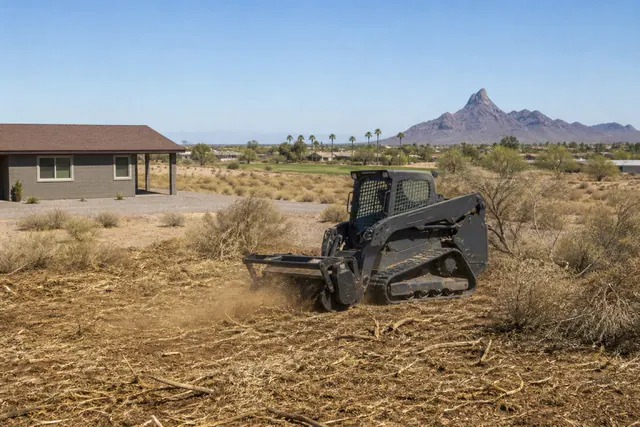
Sun Corridor Land Clearing connects Arizona City property owners with a local land clearing contractor for land clearing, brush removal, and lot clearing across the Arizona City area.
Arizona City is the corridor's largest unincorporated community — 9,868 residents at the 2020 Census, swelling by thousands more when winter residents arrive — laid out in the 1960s as a grid of acre and half-acre lots around a golf course and a 48-acre man-made lake. That platting history defines the clearing work: thousands of lots were surveyed decades ago, a fraction were ever built on, and the rest cycle between owners as raw creosote parcels waiting for their turn.
The vacant-lot economy drives most calls. Owners a time zone away get Pinal County weed notices about growth they've never seen; buyers want a lot mowed so they can actually walk what they're purchasing; neighbors want the tumbleweed farm next door knocked down before it drifts against their block wall. A single machine day handles the typical Arizona City lot — mow the annuals, mulch the volunteer mesquite, leave the healthy creosote — and the parcel goes from liability to presentable.
Build-outs are the second wave. Manufactured-home sets and site-built homes go onto these lots steadily, each needing the full small-parcel sequence: clearing, pad grading with fill to lift above the dead-flat grade, a drive to the paved road, and dust kept down on ground that is among the sandiest in the corridor. The flat land makes the machine work easy; the fine soil makes the stabilization matter.
The absentee-owner playbook for a lot you can't visit
Most Arizona City clearing is arranged remotely, and the workable pattern is simple: the owner sends the parcel number, the contractor walks and photographs the lot, the quote comes back with before images attached, and after photos close the loop when the work is done. Pinal County's parcel viewer at pinal.gov is the shared reference for boundaries, and the county's code-compliance letters state exactly what condition ends the case — forward one with your request and the scope writes itself.
Repeat service is the money-saver here: a lot mowed every other spring stays a two-hour job forever, while one left five years grows woody enough to need mulcher time. Standing arrangements with a season trigger cost less than reacting to notices.
Flat, sandy, and windy: clearing without feeding the dust
Arizona City sits on some of the finest-textured soil in the basin, on a flat with a long wind fetch — the combination that turns a carelessly scraped lot into the neighborhood's dust source and, in the worst events, a contributor to the blowing-dust hazards that close I-10 nearby. Clearing practice compensates: cut high, leave the root mat and soil crust intact, mulch woody material back onto the surface, and never blade bare except where a pad is actually going. Regional dust conditions are trackable on AirNow, and the fire-and-dust weather that shapes summer work schedules comes through the NWS Tucson office, which covers this part of Pinal County.
Golf-course and greenbelt adjacency adds one more courtesy: chips and cuttings stay on the owner's parcel, and clearing along shared edges gets coordinated so the community's maintained ground and the private lots meet cleanly.
Further reading
Good to know
I got a weed notice for my Arizona City lot — can you handle it start to finish?
Yes: send the notice and parcel number, and the job comes back to you as a quote with photos, then completion photos for the county file. Most notice-driven mows are scheduled within the compliance window with room to spare.
What does a typical acre lot cost to clear here?
Annual growth and tumbleweed on a flat acre is among the cheapest work in the service area — commonly a few hundred dollars. Lots that have gone woody with mesquite and desert broom run more because machine and hand time both climb. Photos or a walk set the number.
Can you prep my lot for a manufactured home set?
Yes — clearing, pad fill and compaction to the installer's spec, and the drive to the road are the standard bundle on these lots, done in one mobilization. Tell the estimator your setter's requirements and the pad gets built to them.
Should the creosote on my lot stay or go?
Keep what you're not building on: mature creosote is stable, fire-resistant when spaced, and holds this sandy ground against the wind. The usual pattern clears the build zone and drive fully and thins the rest, which also keeps the quote down.
Do winter-visitor season or summer heat change scheduling?
Practically, yes: spring is the sweet spot — annuals cured enough to cut, before fire season peaks — and it's when snowbird owners are still in town to see the work. Summer jobs run early mornings around heat and storm cells.