 Sun Corridor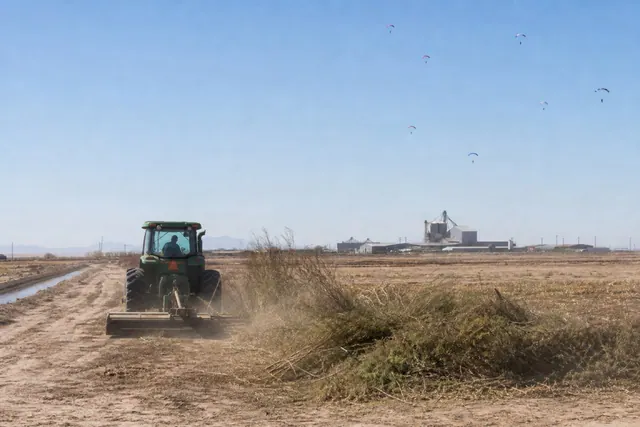
Sun Corridor Land Clearing connects Eloy property owners with a local land clearing contractor for land clearing, brush removal, and lot clearing across the Eloy area.
Eloy is corridor farm country with a census population of 15,635 and a skyline of cotton gins, pivot fields, and — most afternoons — parachute canopies, since the city hosts the world's largest skydiving drop zone. The clearing trade here serves working agriculture and the acreage life around it: field edges kept clean, ditch systems kept open, retired parcels held presentable, and homesites carved out of ground that has been farmed since the railroad found out cotton liked this valley.
Salt cedar is Eloy's signature clearing problem. The irrigation network that makes the farms run also waters the tamarisk that invades every unmaintained lateral and tail-water ditch, and the thickets cost real conveyance capacity while salting the ground beneath them. Ripping those stands out — root crowns and all, timed to the ditch's dry window — is steady work here, along with the mesquite rows that follow every old fence and pipeline across the district.
The town's growth edge adds the rest: new single-story builds going in along the old farm grid, including out toward Toltec, each needing a cleared parcel, a lifted pad, and a dust-compliant site in a stretch of Pinal County where blowing dust is both a federal air-quality matter and an I-10 traffic hazard the region works hard to prevent. Machine work in Eloy runs with water close and the wind forecast open.
Ditch-bank work in an irrigation district town
Clearing along Eloy's laterals is scheduling chess: the work wants the ditch dry, the spoil has to stay out of the channel, and the access road on the bank is often the only machine route — so jobs get sequenced with the water schedule and the district's access rules in mind. Tamarisk removal that lasts means crowns out or cut-stump treatment on the spot; anything less regrows denser, a pattern documented across Southwest waterways by the USGS. For the farm and small-acreage side of managing this ground, the Arizona Cooperative Extension in Pinal County remains the standing local reference.
Field-edge mesquite gets the same treatment logic: grub the line once rather than mow it forever, and the turn rows stay turnable.
Dust, I-10, and clearing responsibly in west Pinal
The stretch of interstate past Eloy and Picacho has a history of dust-driven visibility crashes, and the region's response reaches all the way down to how a single parcel gets cleared: leave the crust where you can, mulch rather than blade, stabilize what's opened, and don't work soil-disturbing operations into a high-wind afternoon. Current air quality sits on AirNow, and the city's own information and services live at eloyaz.gov. It is the rare place where conscientious clearing practice is also, quite directly, highway safety.
The same logic makes mulch-in-place the default finish on Eloy jobs: chips down means ground held, and ground held means the parcel isn't part of the next advisory.
Good to know
Can you clear salt cedar out of my ditch without wrecking the bank?
Yes — the excavator works from the access side, pulls crowns rather than scraping, and leaves the bank's root-bound structure where it's sound. Timing to the dry window keeps the channel clean. Long runs are phased by segment so the district's water schedule never waits on the work.
What does field-edge or fence-line clearing cost around Eloy?
Priced by the run after a walk: light weed lines are quick tractor work, mature mesquite rows with grubbing cost several times more per foot. Farm-scale jobs commonly bundle edges, ditches, and a fallow-parcel mow into one mobilization to keep unit costs down.
Do Eloy parcels have protected native plants to worry about?
On farmed ground, rarely — a century of cultivation removed them. On unfarmed desert edges toward Picacho, saguaros and ironwoods appear and are flagged and preserved like anywhere else in Arizona. The site walk sorts your parcel in five minutes.
Can you prep a homesite on old farm ground near town?
Yes, and it's good ground to build on: flat, deep soil with no protected-plant constraints. The routine additions are ripping the plow pan, lifting the pad with compacted fill, and hunting down the buried irrigation pipe every old field hides.
Does the skydiving traffic overhead affect anything?
Only the scenery — canopies over the gin yards are just Eloy. Machine work proceeds normally; the only aviation consideration is the same one everywhere: no smoke, which this practice never produces anyway since nothing is burned.