 Sun Corridor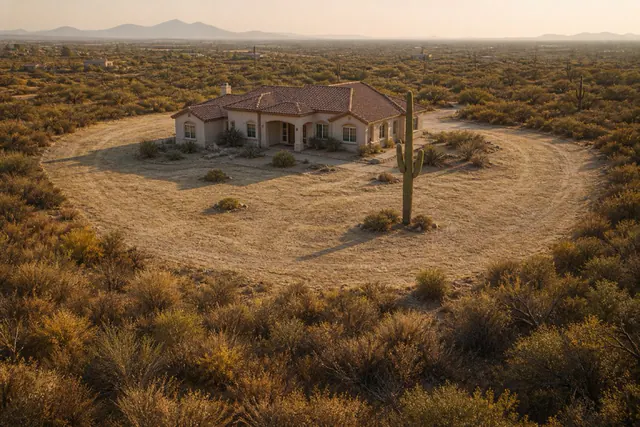
Sun Corridor Land Clearing connects Chandler property owners with a local land clearing contractor for defensible space & fire mitigation clearing in Chandler and down the Sun Corridor.
Desert parcels burn differently than forest, and the difference is grass. The native creosote flat is actually fire-resistant — plants spaced apart, bare ground between them. What changed the equation across the Sun Corridor is invasive buffelgrass and red brome filling those gaps with continuous fine fuel, plus a decade of drought-killed brush standing dead on unmanaged parcels. When summer lightning or a dragged chain finds that mix, fire moves fast, and the homes that survive are the ones with managed space around them.
Defensible-space clearing translates that into machine work: a buffer around structures where dead brush is removed entirely, live desert plants are thinned and limbed so flame can't ladder from grass to canopy, and the invasive grasses are cut hard. On corridor acreage that typically means a clean thirty-foot inner zone around the house, propane tank, and outbuildings, then a reduced-fuel band beyond it — with the saguaros and other protected natives inside the buffer left standing, since a well-spaced cactus is not the fire problem.
The work clusters where homes meet open desert: ranchettes south of Chandler, Arizona City's edges where lots back onto raw creosote, manufactured homes on acreage outside Eloy and Stanfield. For those owners the return is concrete — insurers increasingly ask about brush separation, and a parcel with visible defensible space reads differently on an inspection than one with tumbleweed drifted against the skirting.
The zone logic, translated for Sonoran parcels
The national framework — laid out in the Firewise USA program — describes zones by distance from the structure, and it maps cleanly onto desert ground. Zone one, the first five feet, should be mineral: gravel, not chips, and nothing woody against the wall. Out to about thirty feet, remove dead fuel entirely, cut annual grasses to stubble, and open space between shrubs so no flame front can run continuously. Beyond that, thinning and mowing reduce intensity rather than eliminate fuel. The machine work concentrates in the middle zone, where a mulcher or brush mower does in a day what hand crews do in a week.
Ember behavior drives the details: most desert structure losses start with wind-blown embers landing in something small and dry — a packrat midden under the deck, tumbleweed against the propane tank. The clearing pass hunts those specific accumulations, not just the big brush. The federal Ready.gov wildfire pages cover the household-preparedness half of the same problem.
Buffelgrass: the fuel that changed the desert's math
Buffelgrass deserves its own paragraph on any corridor fire page. It is a perennial African bunchgrass that fills the bare spaces desert fire protection depends on, cures into dense standing fuel, and burns hot enough to kill the saguaros and palo verdes that evolved without fire. Patches establish along road shoulders and disturbed edges first — exactly where parcels meet the county road — and then walk inward. Cutting it is a start; killing established stands usually takes repeated treatment, and the Arizona Cooperative Extension maintains practical control guidance for landowners.
A mitigation pass on this corridor therefore does double duty: it opens defensible space today and knocks the invasive seed load down for next season. Owners who follow the first clearing with an annual touch-up hold the line; parcels left alone for three wet winters are back where they started.
Further reading
Good to know
How wide should my cleared buffer be?
Thirty feet of well-managed space around structures is the working minimum, extending toward a hundred feet on the sides facing open desert or where grass fuel is heavy. On small lots the buffer is whatever depth you own — done thoroughly, even a thin managed band changes outcomes.
Do my saguaros and palo verdes have to go for fire safety?
No. Well-spaced live desert plants are not the hazard — continuous dry grass and dead brush are. Protected natives stay, get the dead material pruned out, and get the fuel beneath them cleared so fire can't climb into them. That's the whole strategy.
When should fire mitigation clearing happen?
Late spring, ideally — once the winter annuals have made their growth and before mid-June, when single-digit humidity and dry lightning arrive together. Fall works too and beats not doing it. The wrong time is a red-flag-warning afternoon in July, when everyone calls at once.
Will my insurance actually care about this?
Increasingly, yes — carriers writing rural Arizona policies ask about brush clearance and some inspect. Beyond the premium question, documented defensible space is the difference-maker in whether a home is defendable at all. Keep the quote and after photos with your policy records.
Is a cleared buffer ugly?
It doesn't have to be. This is thinning and grooming, not moonscaping: the mature cactus and best trees stay, the ground reads as tended desert rather than bare dirt, and gravel or chip mulch keeps the dust down. Most owners think the parcel looks better after.