 Sun Corridor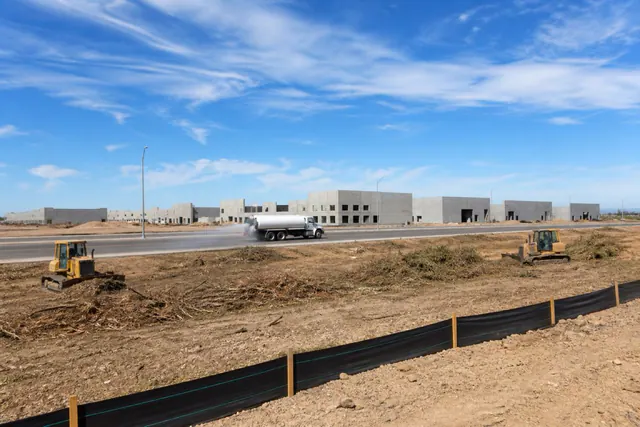
Sun Corridor Land Clearing connects Chandler property owners with a local land clearing contractor for commercial site clearing in Chandler and down the Sun Corridor.
Commercial clearing on the Sun Corridor serves the region's defining economic fact: the ground between Chandler's Price Corridor and Casa Grande's industrial parks is converting from desert and retired farmland into fabs, logistics, housing phases, and the yards that serve them. Site clearing at that scale is a production operation — multiple machines working windrows, haul cycles planned like freight, and a completion date the general contractor's whole critical path leans on.
What distinguishes commercial work here is the compliance envelope more than the machinery. Multi-acre disturbance sits squarely inside dust-control permitting — trained water-truck coverage, stabilized construction entrances, track-out swept before it becomes a citation — and the corridor's west-Pinal segment operates under federal PM10 nonattainment rules that make air quality a schedule risk, not a formality. Add stormwater controls, native-plant survey and salvage coordination on desert parcels, and archaeological monitoring where old ag ground meets older history, and the paperwork crew matters as much as the iron.
Deliverables are contractual: cleared and grubbed to spec, organics off site or processed to approved mulch, subgrade left at survey tolerance, and documentation — daily logs, dust records, disposal tickets — in a package the owner's rep can audit. Phased projects get phased clearing, so raw ground isn't opened earlier than the schedule can protect it; on this corridor, every acre opened is an acre somebody must keep watered and stabilized until it's built on.
Dust compliance as a schedule item
On corridor sites, air quality is managed like safety — planned, staffed, and documented, because a dust violation can stop work as effectively as an accident. That means permit coverage confirmed before mobilization, water capacity matched to the acreage actually open, wind thresholds that pause soil-disturbing operations on high-wind days, and track-out control at every gate. Regional dust events are real here — the same outflow boundaries that produce haboobs will lift an unprotected site wholesale — and the AirNow feed plus NWS Phoenix wind forecasts are part of the daily production meeting, not background noise. The EPA's PM10 material explains the health basis behind the enforcement posture.
Bidders who price dust control thin are advertising where the change orders will come from. A clearing contractor fluent in the rules protects the GC's schedule — which on fast-track corridor projects is the actual product being sold.
Native plant surveys and clearing desert parcels legally
Raw desert acreage carries obligations retired farmland doesn't: Arizona's native plant law protects saguaros, ironwoods, and other listed species, with notification required before land is cleared and salvage processes for plants that can be moved. Commercial projects handle this as a pre-construction workstream — survey the parcel, tag what's protected, coordinate relocation or preservation-in-place, then release the cleared-to-clear zones to production. Municipal landscape ordinances layer on top; Chandler and Casa Grande both fold native-plant handling into their development approvals.
Done early, the plant workstream costs days; discovered late — a tagged saguaro standing where the grubbing crew expected to work — it costs weeks and goodwill. Experienced corridor clearing contractors treat the survey as the first mobilization, because it is.
Further reading
Good to know
What size projects does this cover?
From single commercial pads and laydown yards up through multi-phase clearing measured in the tens of acres. Below that, the lot clearing service covers residential-scale work; above it, the model still applies — production clearing scales by adding machines and water, not by changing method.
Can you meet a hard mobilization date for a GC?
That's the business. Clearing sits first on the critical path, so commitments are made against confirmed equipment availability and weather margins, and phased releases keep survey, salvage, and permitting from bottlenecking the start. References on schedule performance are fair to ask for.
Who pulls the dust permit — owner, GC, or clearing contractor?
It varies by contract; what matters is that coverage exists before soil moves and that daily compliance is staffed and logged. The clearing contractor can hold it or work under the GC's — the scope letter states which, explicitly.
What happens to the cleared vegetation at commercial scale?
Most brush is processed to mulch on site and either reused for stabilization or hauled to approved facilities; trunk wood and grubbing debris leave on ticketed loads. Burning is not part of commercial practice here. Disposal documentation comes with the closeout package.
How does pricing work on larger clearing packages?
Typically unit-priced per acre by density class, with grubbing, haul-off, and dust control as separate schedule items — which keeps phasing and change management clean. Lump-sum works for tightly defined single-pad scopes. Either way the site walk and density mapping come first.