 Sun Corridor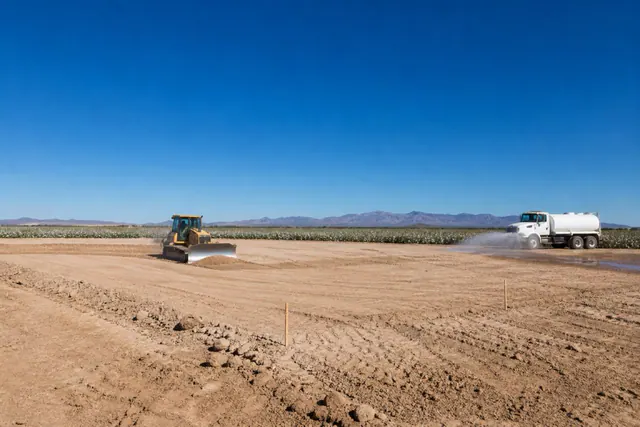
Sun Corridor Land Clearing connects Chandler property owners with a local land clearing contractor for grading & site prep in Chandler and down the Sun Corridor.
Clearing gets the plants off; grading makes the ground usable. On corridor sites that means working this basin's particular soil column — fine sandy loam that grades well when moisture-conditioned, over caliche hardpan that has to be ripped before it will move at all. A pad cut without understanding that column comes out either underbuilt on fluffy fill or overbudget from fighting cemented ground with the wrong machine. Site prep here is really soil logistics: rip, move, water, compact, repeat to the stake tops.
Drainage is the discipline that separates a pad from a problem. Nine inches of annual rain sounds trivial until half of it arrives in monsoon cells that drop an inch in an hour on soil that sheds water like pavement. Corridor grading sets positive fall away from every structure, keeps pads proud of the surrounding flat, and respects where the water historically went — the faint braided washes on a 'flat' desert parcel are the site's drainage memory, and burying them without a plan moves the flood to a surprise location.
Typical scopes run from homesite pads and manufactured-home sets on acreage, through driveway and building-approach grading, to acreage leveling on retired farm ground where old borders and ditch berms have to be knocked down and blended. Every job carries its dust obligations — water on site, controlled track-out — because both counties this corridor spans enforce them, and because the neighbors downwind are the first quality inspection.
Caliche, moisture, and compaction that actually passes
The basin's soils compact beautifully inside a narrow moisture window and terribly outside it — bone-dry loam just shifts under the roller, and the caliche fragments ripping produces need conditioning before they'll seat. That is why a legitimate pad job here always involves a water source, and why 'we'll just blade it flat' quotes should worry you: flat is easy, dense is the spec. Where an engineered pad requires compaction testing, the grading is staged in lifts so the tester can pass each one. Parcel-level soil mapping through the USDA Web Soil Survey is the cheap first look at what your site will demand.
Caliche itself, once ripped and sized, is an asset — it makes a base course that sheds water and carries load, and many corridor jobs re-use it in the drive rather than paying to haul it off and import rock. Good grading plans treat it as material, not obstacle.
Monsoon-proofing a fresh pad
The most expensive time to learn your site's drainage is the first week of August. Fresh grading that goes into monsoon season unprotected can lose its surface, its compaction moisture profile, and occasionally its corners to a single cell. The mitigation is cheap when planned: crown the pad, cut temporary diversion berms on the uphill side, stabilize disturbed ground beyond the pad with chips or track-walking, and schedule concrete or set crews close behind the dirt work instead of a season later. The NWS Phoenix office publishes the monsoon outlooks that make that scheduling more than a guess.
Local jurisdiction matters too: work inside Casa Grande or unincorporated Pinal County follows different grading and drainage approval paths than a Chandler infill lot, and the quote conversation identifies which rulebook your parcel answers to before machines mobilize.
Good to know
What does a house pad cost to grade in this area?
A straightforward pad on already-cleared, level ground is a modest machine job of a day or two; add ripping shallow caliche, imported fill to lift the pad, and compaction testing, and it scales up accordingly. The itemized quote separates cut/fill, import, water, and compaction so the number is legible.
Do I need engineering for a manufactured home pad?
Requirements vary by jurisdiction and foundation type — some setups need an engineered pad with documented compaction, others accept a properly prepared surface. The contractor scopes to your installer's spec and your county's rules, which beats re-grading after the set crew arrives.
Can you fix the drainage on a lot that already floods?
Usually, yes — most 'flooding' on corridor parcels is a pad sitting flush with the flat or a blocked historic flow path. Regrading fall away from structures, adding a swale, or re-opening the path water wants to take solves the common cases. Walking the parcel mid-storm or just afterward is diagnostic gold.
What about the dust rules during grading?
Grading is exactly the activity the dust rules target, so water application, reduced speeds, and track-out control are built into how the job runs — and on larger disturbances, permits are secured before work starts. It's a cost line, but a predictable one, and it keeps you off the hook with the county.
How close to finished grade will the site be left?
To whatever the next trade needs: rough grade for a builder who's bringing their own finish crew, tighter tolerance for a slab-on-grade pour, smooth-and-compacted for a manufactured set. Say what's landing on the pad and the spec — and the price — match it.