 Sun Corridor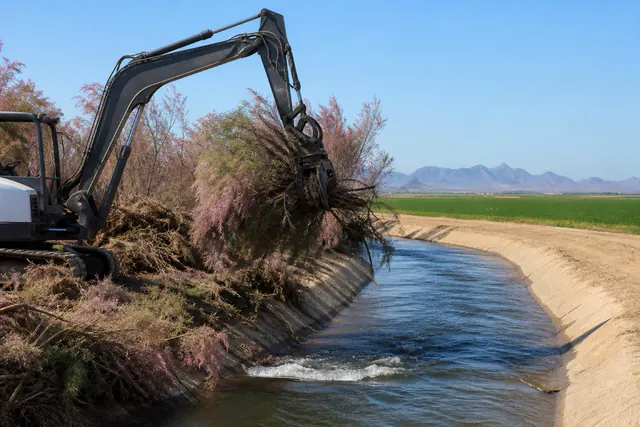
Sun Corridor Land Clearing connects Chandler property owners with a local land clearing contractor for invasive vegetation removal in Chandler and down the Sun Corridor.
The Sun Corridor's problem plants are not natives behaving badly — they are imports engineered by accident for exactly this ground. Salt cedar (tamarisk) packs the washes and ditch banks, drinking the water table and salting the soil beneath it. Buffelgrass and red brome lace the flats with fire fuel. Stinknet, the newest arrival, carpets disturbed ground each spring and triggers allergies half the valley can report personally. Removing them is less like landscaping and more like eviction proceedings against a tenant who knows the loopholes.
The machine work is satisfying and quick: an excavator with a thumb rips salt cedar thickets out of a ditch bank whole, a mulcher flattens a buffelgrass-choked field edge, a mower takes the stinknet down before it seeds. The part that separates a real invasive job from a cosmetic one is the follow-through — salt cedar resprouts from any root left wet, buffelgrass reseeds from the road shoulder, and a single skipped season can refund all the progress. Serious removals are scoped as a knockout plus scheduled follow-ups.
The properties that call for this work map the corridor's plumbing: acreage along the irrigation laterals outside Coolidge and Eloy, wash-crossed parcels near the Gila River bottoms, retention basins on commercial sites, and any ranchette whose 'greenbelt' turned out to be a tamarisk hedge. Clearing them back recovers real things — ditch capacity, fence lines, fire separation, and in the salt cedar's case, the light and water everything else on the parcel was losing.
Salt cedar: why the ditch-bank hedge is a water bill
A mature tamarisk stand is a pump. The trees root to moisture, transpire prodigiously through the irrigation season, and exude salt from their foliage until the ground beneath them grows little else. Along the corridor's laterals and tail-water ditches they also physically choke flow and hide bank damage until it becomes a washout. Removal that lasts means getting root crowns out or treating cut stumps immediately — a chainsaw-only pass produces a denser thicket within two seasons. The Arizona Cooperative Extension and the USGS, which has studied tamarisk across Southwest river systems for decades, both document how persistent the species is once established.
Timing the rip for the ditch's dry window keeps the work clean and keeps mud out of everyone's water. Irrigated-parcel owners should coordinate with their ditch schedule — a detail the contractor asks about on the first call.
Stinknet and buffelgrass: catch them in the right month
Both of the corridor's grass-and-forb invaders run on a calendar. Stinknet germinates with winter rain, flowers into its yellow-globe stage by March, and cures into allergenic, flammable duff by May — cut or pull it before flowering and you remove next year's seed; wait until it browns and you are just rearranging it. Buffelgrass greens up with summer rain when everything native is dormant, which ironically makes late summer the easiest time to spot every clump on a parcel. Treatment guidance from the Cooperative Extension is worth reading before deciding between mechanical and chemical follow-up.
Air quality is the quiet second reason to care: invasive annuals dying on disturbed ground leave bare, powdery soil behind, feeding the dust that keeps parts of this corridor on the wrong side of federal PM10 standards — current conditions are always visible on AirNow. A removal finished with ground cover — chips, gravel, or re-established natives — fixes the problem instead of trading one for another.
Further reading
Good to know
How do I know if the tree line on my ditch is salt cedar?
Look for feathery, cedar-like foliage on many slender reddish stems, pink flower plumes in season, and a salt crust or bare ground underneath. If it grows in a dense wall along water and nothing grows under it, it is almost certainly tamarisk. A photo with your quote request settles it.
Can invasives be removed permanently?
Permanently is a strong word for species this good at coming back — honestly, the standard is control: a hard initial removal, then brief scheduled follow-ups that catch resprouts and new seedlings while they're cheap. Two or three seasons of that and most parcels stay clean with minimal effort.
Is buffelgrass really that big a fire risk?
Yes — it fills the bare gaps that normally stop desert fire and burns hot enough to kill saguaros. It's the main reason a grassy parcel edge near structures should be treated as a fire problem, not a lawn. Removal doubles as defensible-space work.
What does a wash or ditch-line clearing cost?
Salt cedar density and access drive it: a hundred feet of young thicket is modest work, while a mature stand wrapping a quarter mile of lateral is an excavator project with real haul volume. Quotes follow a site walk, and phasing by segment is common on long runs.
Do you spray, or just cut?
The machine work — ripping, mulching, mowing — is the core of the job. Where a species demands chemical follow-up on cut stumps or regrowth, that gets flagged in the plan so it's handled properly and legally rather than left to guesswork. The quote is explicit about which approach each species on your parcel needs.