 Sun Corridor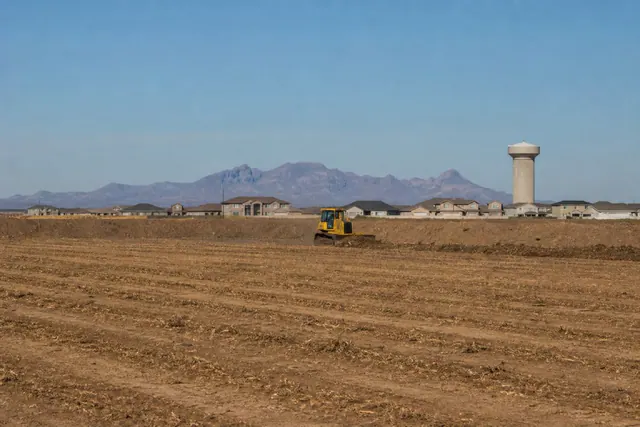
Sun Corridor Land Clearing connects Casa Grande property owners with a local land clearing contractor for land clearing, brush removal, and lot clearing across the Casa Grande area.
Casa Grande counted 53,658 residents in the 2020 Census — up from 48,671 a decade earlier — and the growth since has been visible from the machine seat: subdivision phases grubbed out of retired cotton fields, industrial parks rising along I-10 and I-8, and acreage buyers pushing onto the desert flats around the city's edges. Clearing work here splits between the two kinds of ground that meet at the city limits: century-farmed field soil and untouched creosote flat.
The farmed ground is the easier read. Laser-leveled fields that came out of cotton or alfalfa carry tumbleweed, volunteer mesquite along the old ditch lines, and buried irrigation hardware — but no protected native plants and no surprises in the soil column beyond the plow pan. Desert parcels are the reverse: saguaros and ironwoods that Arizona law protects get surveyed and flagged first, and the caliche runs shallow enough on the flats around Casa Grande Mountain that grubbing quotes always mention ripper time.
Dust is the discipline every Casa Grande job carries. The city sits in western Pinal County's PM10 problem area, where blowing dust from disturbed ground is a federal air-quality issue, so clearing runs with water on site, mulch or stabilization on anything left open, and track-out kept off the city's roads. It is a working constraint — and also the reason mulch-in-place clearing has become the default technique on this side of the corridor.
From cotton rows to cul-de-sacs: clearing the growth edge
Most of Casa Grande's new rooftops sit on ground that was in cotton a generation back, and converting a retired field to buildable phases has its own sequence: knock down the border berms, grub the ditch-line mesquite rows, locate and remove the gated pipe and concrete stubs, then rip the compacted pan so utilities trench clean. The old field engineering actually helps — the ground is already flat and the soil deep — which is part of why this side of the corridor builds so fast. The city's development pipeline and permitting live at casagrandeaz.gov, and parcel soils can be checked ahead of any dirt work through the USDA Web Soil Survey.
For individual owners, the same logic scales down: an acre of old field outside the city clears cheaper than an acre of desert, and the quote will reflect which kind of ground you bought.
Acreage life on the flats: what Casa Grande owners maintain
The ranchette belt around Casa Grande — toward Arizona City, out past the mountain, along the Selma Highway corridors — runs on a maintenance rhythm: tumbleweed mowed before June cures it into fuel, fence lines kept open, defensible space held around homes that back onto open desert. The fire logic is the standard one laid out by Firewise USA, applied to a landscape where invasive grasses are the fuel that matters. Monsoon outflow winds are the other seasonal event; the NWS Phoenix office covers Casa Grande's warnings, and the late-summer cleanup calls track their storm reports almost exactly.
Owners who put one clearing pass on the spring calendar — brush down, washes open, buffer held — spend less across the year than those who let the parcel argue its case in July.
Further reading
Good to know
Do I need a dust permit to clear a lot in Casa Grande?
Depending on the area disturbed, yes — western Pinal County's air-quality rules put thresholds on earthmoving, and the city applies its own requirements inside the limits. The contractor scopes which requirements your parcel triggers as part of the quote rather than leaving you to find out by letter.
What does an acre cost to clear around Casa Grande?
Old field ground with light weed cover sits at the economical end; native desert with mesquite thickets, protected-plant flagging, and shallow caliche grubbing costs more per acre. Both get quoted after a walk, itemized into clearing, grubbing, and haul so the drivers are visible.
Are there saguaros on Casa Grande parcels, and what happens to them?
On native desert parcels, frequently — and they stay. Protected plants get flagged before machines move, and cut lines route around them. Retired farmland, by contrast, almost never carries protected natives, which is one reason it clears cheaper.
Can you clear a phase for a builder on a schedule?
Yes — production clearing with dust compliance and documented deliverables is the commercial half of the practice, and Casa Grande's subdivision and industrial work is exactly where it runs. Mobilization dates are committed against confirmed equipment, not hope.
My parcel by the mountain has thin rocky soil — different job?
Somewhat: the bajada ground near Casa Grande Mountain runs rockier and carries denser cactus, so clearing leans selective — mulching lanes and pads while leaving the saguaro-and-cholla slopes intact. It's slower per acre and quoted accordingly.