 Sun Corridor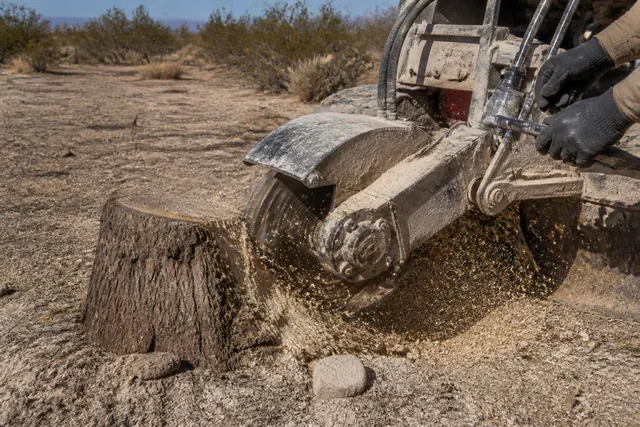
Sun Corridor Land Clearing connects Chandler property owners with a local land clearing contractor for stump grinding in Chandler and down the Sun Corridor.
Every removed tree leaves the question of the stump, and in this basin the question has teeth: a mesquite stump left at grade is not dead, it is regrouping. Stump grinding answers it mechanically — a carbide-toothed wheel chews the stump and the top of the root crown into chips, typically six to twelve inches under grade — enough depth to kill the resprout buds and leave ground you can rake, plant, or pave.
Corridor jobs split into two families. The first is desert natives: mesquite crowns after a removal or an old clearing job done halfway, and palo verde stumps that a previous owner cut flush and declared victory over. The second is the legacy shade and orchard trees of the ag towns — aleppo pines and mulberries in older Chandler and Casa Grande yards, athel tamarisks planted as windbreaks in the 1950s, even old citrus. Each grinds differently; dense mesquite is slow, punky athel is fast and messy.
Grinding is also the tidy end of bigger clearing work. A lot cleared for a future pad gets its stumps ground rather than cratered out where excavation would disturb more ground than the build needs, and fence-line or driveway projects use the grinder to erase the stubs the mulcher can't take below grade. The chips stay on site as fill for the hole unless the spot needs clean dirt — that choice is a line on the quote.
Why flush-cutting a mesquite never ends the story
Mesquite carries dormant buds on the root crown, at and just below the soil line, and cutting the trunk simply hands the root system's stored energy to those buds. The result is the many-stemmed regrowth clump you see on half-cleared parcels all down the corridor — harder to remove than the original tree. Grinding wins because it destroys the crown itself; the deep roots left behind cannot resprout without it and simply decay in place. Guidance from the University of Arizona Cooperative Extension on managing mesquite regrowth backs the same principle: the crown is the target.
Depth is the honest spec. Six inches below grade handles lawn-and-landscape situations; going deeper matters where a slab, footing, or driveway will cross the spot, so the decayed zone doesn't become a soft pocket under something rigid. Say what's going on top of the ground when you ask for the quote and the depth gets set accordingly.
Grinding around hardpan, pipes, and desert landscaping
Two local realities shape the work. First, caliche: where the hardpan runs shallow, roots flare sideways along the top of it, so corridor stumps are often wider and shallower than the same species elsewhere — the grind pattern follows the flare, not just the visible stump. Second, buried lines: older acreage properties carry decades of undocumented irrigation pipe, and utility locates plus a probe around the stump come before the wheel spins. A soil check via the USDA Web Soil Survey tells an operator a lot about what the roots did underground before anyone digs.
In finished desert landscaping, the grinder is the surgical option — it reaches a stump between boulders and drip lines without re-grading the yard. Chips get contained as the wheel works, the hole is backfilled and tamped, and the decomposed-granite surface goes back over the top like nothing was ever there. Work near a public sidewalk or right-of-way can be checked with the City of Chandler before the machine is scheduled.
Good to know
What does stump grinding cost around Chandler?
Single accessible stumps commonly run in the low hundreds, with price scaling on diameter, species, and access — dense mesquite costs more wheel time than soft athel. Multiple stumps on one visit drop the per-stump price substantially, which is why clearing jobs bundle them.
How deep do you grind?
Standard is six to twelve inches below grade — enough to kill resprouting and allow replanting or gravel over the top. Spots destined for concrete or structures get specified deeper. Tell the estimator what the ground will become and the depth follows.
Will the mesquite grow back after grinding?
Not from a properly ground crown. Watch the spot the first summer: occasional shoots from a missed lateral root can appear and are easily handled while small. What you will not get is the aggressive multi-stem regrowth that follows a flush cut.
Can you get a grinder into my backyard?
Usually — compact machines fit through a standard gate opening, and tight-access yards in older Chandler neighborhoods are routine work. Genuinely landlocked stumps can be handled with smaller equipment at a slower pace; access comes up in the first minute of any quote call.
What happens to the chips and the hole?
Default is chips back in the hole, mounded slightly to allow settling, with excess raked or hauled per your preference. If the spot will be planted or paved, clean backfill compacted in lifts is the better spec and gets priced as a line item.