 Sun Corridor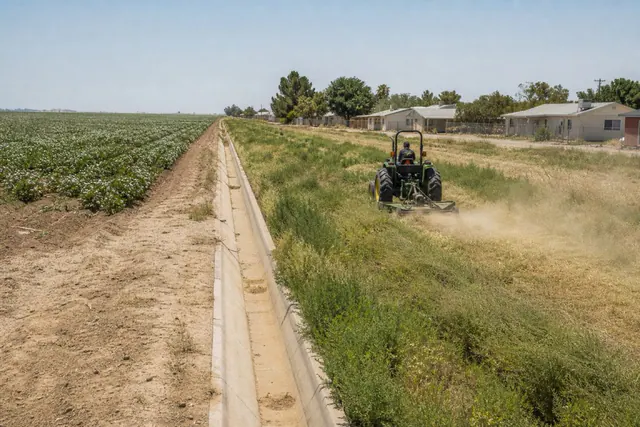
Sun Corridor Land Clearing connects Randolph property owners with a local land clearing contractor for land clearing, brush removal, and lot clearing across the Randolph area.
Randolph is one of the corridor's historic farm settlements — a modest grid of homes near Coolidge, surrounded by cotton ground, with a community identity that long predates any map most newcomers use. Established by Black farmworker families in the early twentieth century and still carrying that heritage, it's a community where land tends to stay in families, and where clearing work is about keeping ground serviceable across generations rather than flipping it.
The parcels tell the settlement's story: house lots on the grid with field strips behind them, fence lines shared for decades, and the overgrowth that accumulates wherever a strip sits fallow between uses — tumbleweed and dried annuals mostly, with volunteer mesquite testing every ditch line and yard edge. The typical job is straightforward and satisfying: the strip behind the houses bush-hogged clean, the fence lines opened, the yard edges pushed back, all in a machine day or two.
Being unincorporated Pinal County ground in the middle of an irrigation district, Randolph's work follows farm-country rules — coordinate with the water schedule where ditches are involved, keep dust down on ground that neighbors working fields, and leave the parcel looking like somebody local cares about it, because somebody local does. Word-of-mouth is the whole marketing plan in a community this size, and the work is done accordingly.
Family land, kept usable: small-parcel maintenance that compounds
Land that stays in a family for generations accumulates both meaning and deferred maintenance, and the second kind compounds fastest: a fallow strip left three seasons grows woody enough that a mulcher, not a mower, is what it takes, and a fence line left ten needs rebuilding instead of clearing. The economical pattern for Randolph parcels is a standing annual pass — strips mowed green, fence lines held, mesquite volunteers caught at lopper size — which keeps every future option open, from replanting to a family build to a clean lease. Small-acreage management guidance from the Arizona Cooperative Extension maps well onto exactly this kind of holding.
Where a build is coming — a family member's manufactured home on the back strip is the classic Randolph project — the same clearing visit can rough the pad location and drive line, so the ground is ready when the paperwork is.
Working inside the district: water, dust, and neighbors
Randolph sits in the middle of the corridor's irrigated heart, which shapes the practical details: ditch-adjacent clearing coordinates with delivery schedules, spoil and chips stay out of channels, and machine traffic respects the field roads that working farms depend on. Dust discipline is the same as everywhere in west Pinal — mow high, mulch in place, water anything bladed — both because the county requires it and because the downwind neighbors are the community itself. Jurisdictional questions run through Pinal County, with Coolidge as the service town for most everything else.
None of it is complicated; all of it is noticed. In a settlement where everyone knows whose machine was on whose parcel, doing the small things right is the business model.
Further reading
Good to know
What does it cost to clean up a Randolph field strip?
Light fallow growth on a typical strip is a modest tractor job — the economical end of corridor pricing. Woody growth or ditch-line mesquite adds machine time. A walk or photos price it quickly, and annual repeat service costs less than either.
Can several family parcels be done in one visit?
Yes, and it's the smart way to buy the work — adjacent or nearby parcels share the mobilization, and the per-parcel cost drops. Multi-owner family arrangements are normal here; the invoice splits however the family wants it.
Do you work around active farming next door?
Always — that's Randolph's context. Scheduling avoids the neighbors' critical field operations, dust is held down, and field roads are treated as the shared infrastructure they are. Farm-country courtesy is part of the job spec.
Can you prep ground for a family manufactured-home set?
Yes — clearing, pad, and drive as one package is the standard path for putting the next generation on family land, built to the installer's spec and county requirements. It's among the most common jobs in settlements like this.
Is there anything protected on old farm ground here?
Rarely — this ground has been cultivated for a century, so protected native plants are uncommon on the strips and lots. Any exception on an untouched corner gets flagged and kept, same as anywhere in Arizona.