 Sun Corridor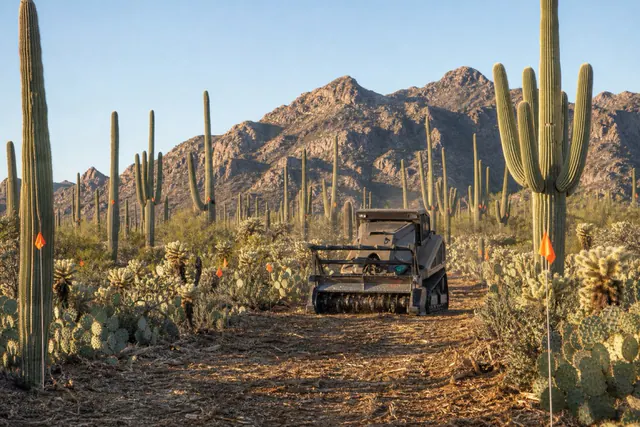
Sun Corridor Land Clearing connects Cactus Forest property owners with a local land clearing contractor for land clearing, brush removal, and lot clearing across the Cactus Forest area.
Cactus Forest wears its name honestly: 606 residents at the 2020 Census scattered across large-lot desert east of Florence, in some of the thickest saguaro, cholla, and prickly pear country the service area touches. People live here because of the desert, not despite it, and the clearing trade adjusts its whole posture accordingly — this is the one community on the map where the default answer to 'clear it' is 'which exact parts?'
The method is selective to the plant. Homesites, drives, and defensible space get cleared as narrow, deliberate envelopes; everything protected — and in Cactus Forest that's a long list per acre — gets flagged, logged, and worked around with machine lanes planned like surgery. Mulching handles the shrub layer between keepers; hand crews take the final feet around every cactus; and the finished parcel reads as intact desert with living space fitted into it.
The community's fire relationship is sharpened by what's at stake: a dense cactus forest is exactly the landscape that invasive-grass fire destroys permanently, since saguaros neither survive burns nor return quickly after them. Fuel management here — buffelgrass and red brome cut before cure, dead brush out of the understory, buffers held around structures — protects both the homes and the namesake forest itself. It's clearing in service of not clearing, and owners here understand that better than anyone.
Surgical clearing: how a lane goes through a cactus stand
The sequence on a Cactus Forest parcel: walk and flag every protected plant along the intended corridor; adjust the corridor to miss as many as the geometry allows; log what remains as genuine conflicts and resolve each one — redesign, or state-coordinated salvage — before any machine starts; then cut the lane with a mulcher sized small enough to maneuver the gaps, finishing edges by hand. It's slower per foot than open-flat work and worth every minute, legally and aesthetically. The regulatory floor is Arizona's native plant law; the species knowledge lives with resources like the Arizona Cooperative Extension, and parcel terrain and soils can be scouted via the USDA Web Soil Survey before the walk.
Buyers should price this reality in: a Cactus Forest acre clears slower than a Casa Grande acre, and any quote that doesn't say so hasn't seen the parcel.
Defending the forest: fuel work as preservation
Saguaro country's existential threat is the grass-fire cycle: invasive annuals fill the bare inter-plant spaces, burn hot in June, and kill cactus that took a century to grow — after which the grasses return first and burn again. Breaking that cycle on a private parcel means cutting the fine fuel every spring before it cures, keeping dead wood out of the understory, and holding proper Firewise buffers around the structures so an ignition doesn't reach the stand at all. Red-flag timing for this end of the corridor comes from the NWS Tucson office.
Neighbors here increasingly coordinate the spring fuel pass — a few machine days covering adjacent parcels builds a community-scale break for the cost of a private one, and the forest the community is named for is the beneficiary.
Further reading
Good to know
Can I even clear land in a place called Cactus Forest?
Yes — homesites, drives, and fire buffers are cleared here routinely. What changes is the method: protected plants are mapped first and the clearing is designed around them, which Arizona law requires and the property's value rewards.
How much more does selective clearing cost?
Per cleared acre, meaningfully more than open-flat work — the survey, the maneuvering, and the hand finishing all add time. But Cactus Forest scopes are small by design: you're clearing an envelope, not a parcel, so totals stay reasonable.
What about cholla — is it protected too?
Several cactus species carry protection under state law beyond the saguaro, and the practical Cactus Forest standard is to treat the whole cactus community as keep-by-default, removing only what the envelope requires. The survey walk sorts species and status plant by plant.
Can you do just the fire-fuel pass without any real clearing?
Absolutely — a spring mow of the invasive grasses and a dead-brush pull, structures buffered, cactus untouched. It's quick, it's the single highest-value service for this community, and repeat scheduling keeps it cheap.
My drive needs to wind through heavy cactus — possible?
That's normal Cactus Forest access work: the corridor bends to the stand, crossings and sight lines get engineered where the geometry allows, and the result is the classic desert drive that arrives at the house through the forest rather than through a clearing.