 Sun Corridor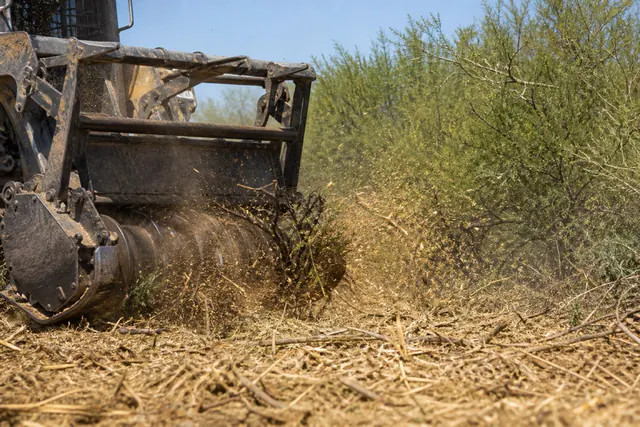
Sun Corridor Land Clearing connects Chandler property owners with a local land clearing contractor for forestry mulching in Chandler and down the Sun Corridor.
Forestry mulching is the workhorse of desert clearing between Chandler and the Pinal County line: a tracked carrier pushes its drum mulcher straight into the standing brush, and what was a head-high thicket of velvet mesquite and creosote becomes a carpet of chips in a single pass. There is no piling, no burning — which matters in a valley where outdoor burning is tightly restricted — and no convoy of debris trucks running your dirt onto the county road.
The chip layer the machine leaves behind is not waste; it is the cheapest ground stabilizer you can put on Sonoran soil. Bare-scraped desert around the Sun Corridor turns to powder within weeks and starts feeding every wind event from spring gusts to a July haboob. A few inches of mulched mesquite holds that fine sandy loam in place, shades the surface, and slows the tumbleweed and desert broom that otherwise rush into any freshly disturbed patch.
Mulching also happens to be the most surgical way to clear around what must stay. Machines work parcel edges in Chandler infill lots and ranchette acreage down toward Casa Grande where saguaros, ironwoods, and old blue palo verdes are flagged to remain — the drum takes out a single mesquite ten feet from a protected cactus without disturbing it. Where a dozer wants a clean sweep, a mulcher takes the parcel plant by plant.
What a mulcher does to mesquite that a blade can't
Velvet mesquite is the defining clearing problem of this basin. Push one over with a blade and you drag a root crown and a half-ton of soil with it, leaving a crater and a tree that frequently resprouts anyway. A mulcher instead shears the tree to grade and pulverizes the top growth, leaving the roots to hold the soil. For pasture edges, view corridors, and fire buffers — anywhere you don't need a buildable pad — that trade is almost always the right one. The University of Arizona Cooperative Extension publishes good guidance on managing mesquite and desert brush on small acreage.
Where a job does need grubbing — a future building footprint, a septic field, a driveway line — the mulcher still earns its keep by processing the top growth first, so the excavator that follows is pulling clean root crowns instead of wrestling whole canopies. On mixed parcels the quote splits it plainly: mulch the acreage, grub the pad.
Dust, chips, and the rules that shape a Chandler job
Chandler sits in a county where earthmoving comes with dust obligations, and the west Pinal side of this service area carries federal PM10 nonattainment rules on top — see the EPA's particle pollution pages for what that designation means. Mulching is the friendliest technique under those rules because it disturbs the soil surface least: the tracks ride on chips, not on tilled dirt, and there is no scraper stripping the crust off an acre at a time.
Timing is the other lever. The best mulching window runs October through May, before the monsoon pattern sets up — the National Weather Service Phoenix office tracks the season's onset each June. Clearing dry fuel ahead of summer lightning, and ahead of the microburst winds that scatter loose brush across a neighborhood, is worth more than any other scheduling decision a parcel owner makes here.
Further reading
Good to know
How many acres can be mulched in a day around Chandler?
Light creosote and bursage flats can run two to four acres daily under one machine; dense multi-trunk bosque can pull that under an acre. Density is the whole story, which is why quotes here follow a walk of the actual parcel rather than a per-acre rate quoted blind over the phone.
Does the mulch attract termites or scorpions?
A thin, spread chip layer dries fast in this climate and is a poor termite habitat — problems come from buried wood and thick, wet piles, which a good operator doesn't leave. Keeping chips a few feet back from slabs and stem walls is standard practice and part of the finish pass.
Will mulching kill the mesquite for good?
Cut to grade, mesquite and desert broom will often push back from the crown. On parcels you want to keep open, plan on a light maintenance pass every year or two, or pair mulching with selective grubbing of the crowns in the zones that must stay clean. The quote can price both approaches side by side.
Can you mulch right up against my saguaros?
Yes — that's one of the technique's main advantages. Protected plants get flagged first, the operator works a respectful radius around each one, and hand crews trim anything inside that radius. Saguaros and ironwoods are protected by Arizona law and are never cut, mulched, or pushed.
Is burning the brush ever an option instead?
Practically speaking, no. Open burning is heavily restricted across the valley and the dry season makes it dangerous besides. Mulching removes the need entirely — the debris is processed where it fell, and nothing smolders next to your fence line.